The perception of traveling as a means of self-discovery is a principle dating back as far as Herodotus. Traveling helps us establish a comparison between the customs and the ethics we deem familiar and those of the others in order to perceive ourselves in another light, he claims. Provided the traveler manages to gather some extra courage and readiness, the voyage could be life-altering, broadening his own horizons. I enjoy taking up the perspective of a contemplator of the world and as such, I highly value silence, whose importance is rarely comprehended. Silence is essential when it comes to the art of contemplating the moment, the need to go your own way, alone, without the slightest distractions induced by the others, which is very much a thing that intrigues me. It has nothing to do with tourism; instead, it’s a way of experiencing and re-experiencing equivalent to discovering your own self. Every single time I return home I find myself a little more changed, yet a little more me.
Traveling as part of the Erasmus program enables not only encountering your real self, but encountering others as well. This time my favorite red ballet flats took me to the University of Ankara, the capital of Turkey, seated cozily among the hills of the Anatolian plateau. The city itself seems unmeasurable, many-faced, with a population of 5.5 million people and an altitude of 900 meters, ostensible only in case you decide to trust your two feet to explore it. The moment you land at the local airport two bus agencies are awaiting you right at the exit, so don’t worry, the danger of missing the city is none.
I was accommodated in the proximity of the Maltepe metro station since the Ankara University is just a minute away. Metro stations are overflowing with security staff who quite often scan your luggage before you enter the metro – an extra security measure.
The University of Ankara was founded in 1946 and represents the first university to open its doors after Turkey’s inauguration as a republic by Kemal Atatürk. His full-sized portraits are omnipresent.
The university consists of as many as 17 faculties and offers education to 70,000 students! Located on a vast green space, its many institutes and centres are positioned in various buildings. The conferences I contributed to took place in the beautiful Senate Hall.
The Erasmus Department of the University is extremely active in every aspect, whether it is international activity, new partnerships and even supporting future partners from the European Union in initiating common projects and signing collaborative contracts. The fact that a special mobile application allowing foreign students to obtain any needed information in relation to the study process, documentation and student life with a simple click has been developed left a lasting impression on me. It goes as far as helping students navigate through the studying environment, cultural events, restaurants and many more! Professor Süzen, the director of the Erasmus department, makes every guest feel at home, me included, thanks to her energy and her liveliness!
As a part of a rich and diverse cultural program, our hosts took upon themselves to organize a visit of the Mausoleum of Atatürk – Anıtkabir. A paved alley leads the way to the monument, as grass is intentionally grown in between the plates. It makes it impossible for one to stroll around without paying attention and watching their step. I was surprised to learn it was an original idea of Atatürk, something that has been recreated even here: not to forget that one should often look at the ground while walking through life! Many of Atatürk’s belongings are exhibited in his mausoleum and also a full-size copy of his figure. An astonishing view of the city peeks through the narrow windows.
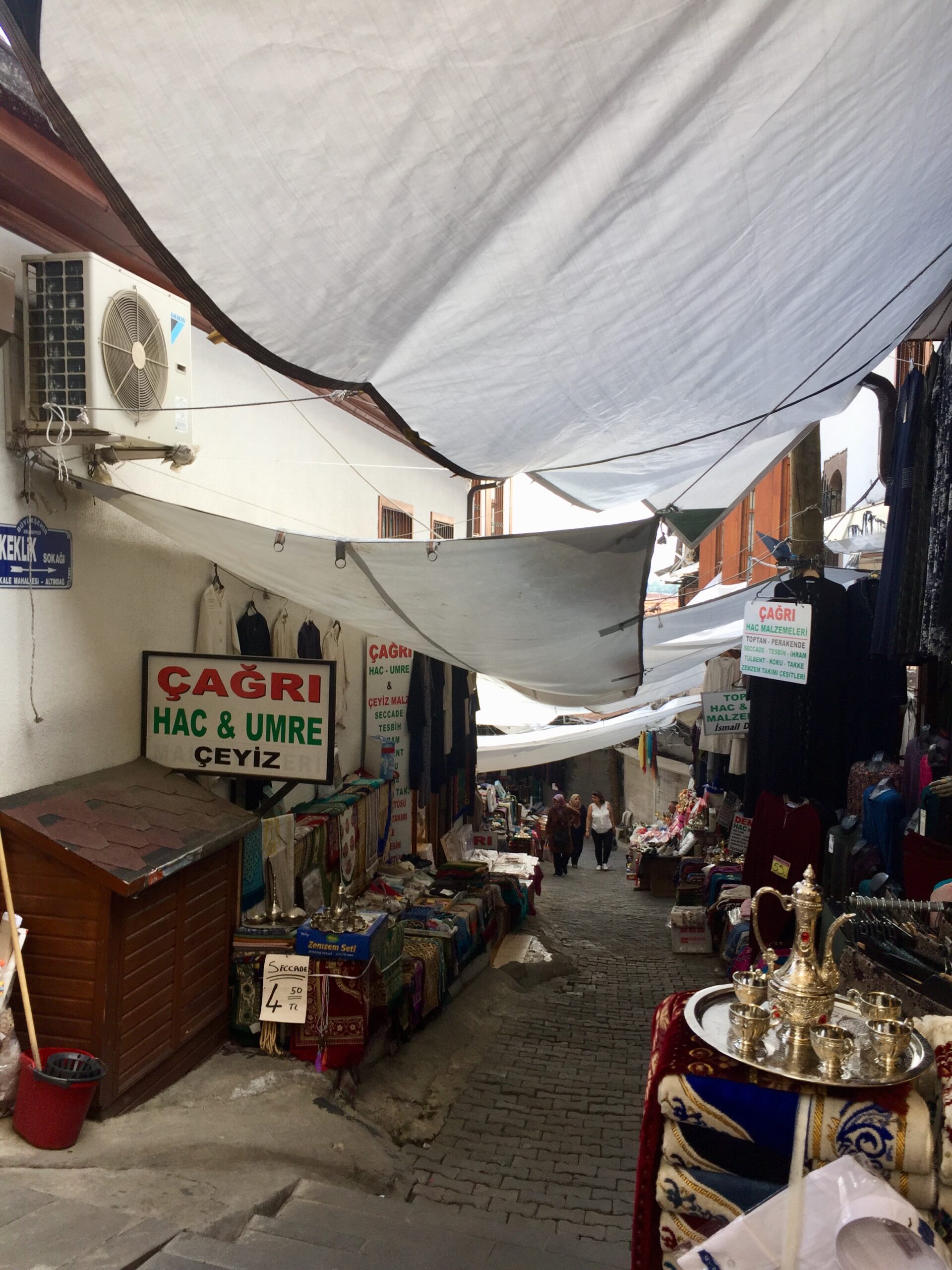
If you ever find yourself in Ankara, you should most definitely take the time to visit the old part of the city, on foot, just like I did! It’s well worth it! You would traverse little lanes, where locals reside, filled with bridal dresses and accessories, hen’s party attires, head scarves, drapes, bracelets, markets offering everything you could think of, buzzing with the hollers of vendors asking you to check out their merchandise.
Our promenade ends at the mosque of Hacı Bayram, built in 1427. Unfortunately for me, I failed to enter into the mosque, as a separate place is established for women. It is situated at the end of the square in front of the mosque, underground. An escalator takes you to the shoe lockers, as well as to a designated washing area. Further along the way the space is reigned by silence and tranquility. A rose-coloured light radiates in the halls. On the side you can find the Koran, accompanied by little foldable holders and praying beads.
In case you manage to reach the Ankara Castle, you will soon comprehend the magnitude of our connection to Turkey. A connection marked not only by the thousands of Turkish words, existing in the Bulgarian language, by our acquired tastes in coffee, by our hospitality and mentality – very often locals treated me as one of their own, as a ‘komşu’ (neighbor), the moment they learned I was Bulgarian – even by the architecture so similar to the one of our own Renaissance: the narrow paved alleys meandering up the hill towards the castle, the little artisanal boutiques tempting you with various merchandise, the pretzel vendors stationed at every corner. I even ran into a couple of honeymooners, taking pictures of themselves on the historic site as a souvenir.
The Erasmus Week in the University of Ankara I participated in as an Erasmus Coordinator of the Philology Faculty of the University of Veliko Tarnovo and a Lecturer of Intercultural Competence for international students was extremely beneficial for me in a multitude of ways. Tons of experience were exchanged in terms of digitalizing of the program reports. Colleagues from Ukraine and the University in Tekirdağ proved to be intrigued by the University of Veliko Tarnovo, thus clearly manifesting their amicable intentions to collaborate and sign partnership contracts in order to enable student exchanges. I, on the other hand, had the opportunity to promote to my colleagues the importance of developing an intercultural competence among foreign students and their integration to the hosting environment, as well as promoting the Veliko Tarnovo University as a study centre open to all cultures.
If you asked me what I took from Ankara, I would answer: I interiorized the rhythm and the pulse of the city, the perception of its many faces, the feeling that Ankara is a city of various extremities weaved together in a complicated scheme, for whose investigation the time would never be sufficient. I took with me the aroma of the coffee, the taste of the strong black tea, the shouts of the vendors, the look in people’s eyes whenever they gave me their seat in the metro, the generosity of our guests, the dances of the improvised hen’s party, the sun shyly rising above the slumbering city. I understood that the university milieu is marked by a feeling of belonging, the feeling that you’re at home, wherever you are. The understanding that contacts above all allow for the reestablishing of education as an interesting challenge. On another note, I got to be on the other side. I was one of the others. That’s enough for me, and what about you?
Neli Peycheva